Two worlds, two ways of thinking
M-Bus is telegram-oriented: the master asks a meter, and the meter replies with its complete data record. BACnet, by contrast, is object-oriented: every reading is an object of its own with type, instance number, name and unit, which the building automation can read individually.
So the translation is not about passing bytes through but about mapping: an M-Bus data record with twelve values becomes twelve BACnet objects. Who does this, and by which rule the objects are named, needs to be settled at the start.
The naming convention is not a formality
The most common pitfall: objects named after the device number. Meter_0815_Value3 is clear on commissioning day and worthless three years later – at the latest after the first device replacement.
A hierarchy by location and function works better: property, building, floor, metering point, quantity. It survives a device change because the metering point stays the same even when the device behind it is replaced. The same logic applies to MQTT topics.
Agree on the scheme before the first object is created. Renaming afterwards means re-linking every connection in the building automation.
BBMD: when BACnet has to cross subnets
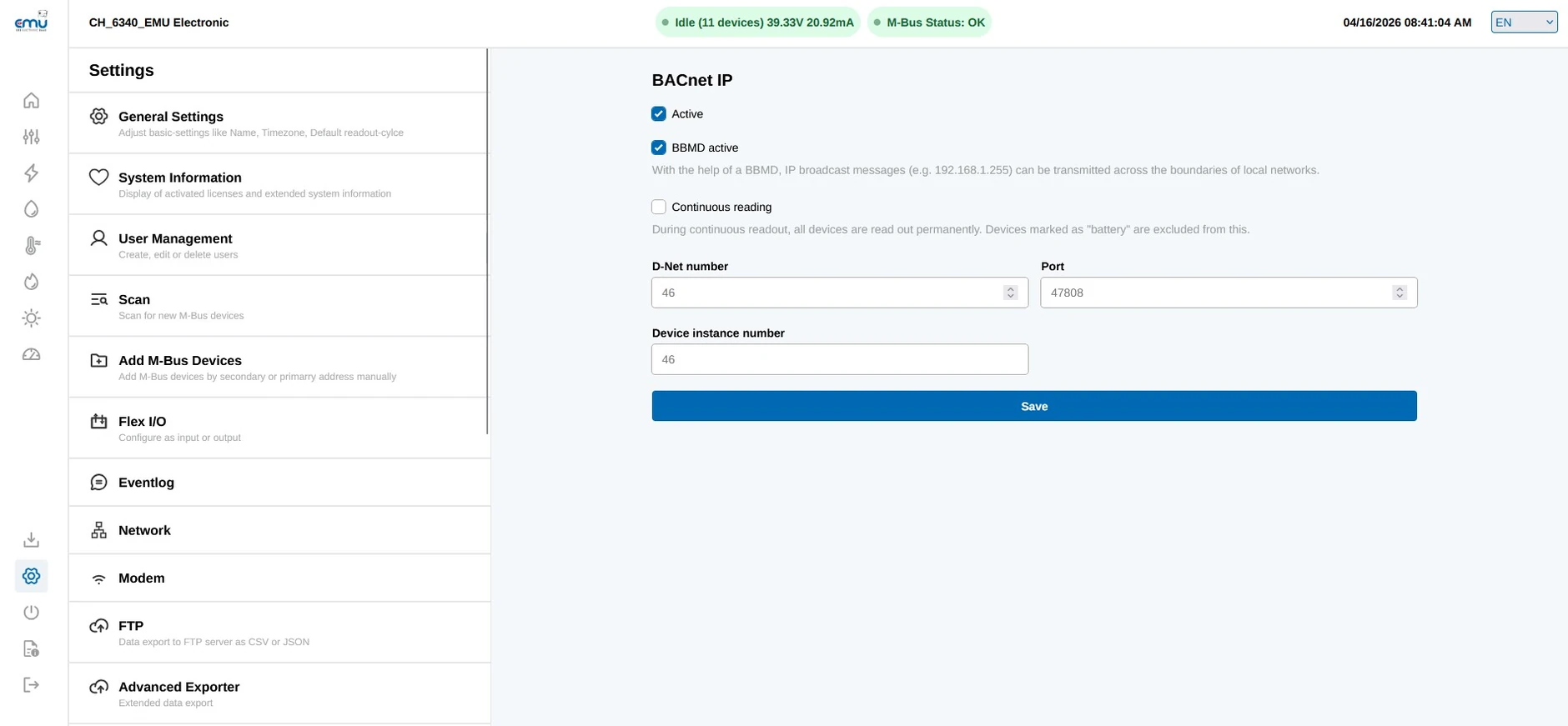
BACnet/IP works with broadcasts, and broadcasts stop at the subnet boundary. As soon as the building automation and the metering system sit in different network segments – in practice almost always, because metering usually gets its own VLAN – you need a BBMD, a BACnet Broadcast Management Device.
The EMU M-Center includes the BBMD function and is certified for BACnet IP as B-ASC. The BACnet function requires a licence; the order number is in the datasheet.
Several consumers, one source
An advantage that often gets lost in planning: the building automation is not the only consumer. The same M-Center passes the same values in parallel via MQTT to a dashboard, via (s)FTP or e-mail as CSV to billing and via Modbus TCP to another system.
This defuses a typical debate. The question “do the meter data belong to the building automation or to energy management?” does not need an answer, because both get them – from the same source, with the same timestamps.
Clarify before talking to the controls engineer
- Which readings does the building automation really need – all of them or five per meter?
- In which network segment is the building automation, and is BBMD needed?
- Which scheme is used to name the objects?
- Which update rate is required, and can the fieldbus deliver it at all?
- Who maintains the object list when a meter is replaced?
The second question is most often asked too late, the last one almost never – and it is the one that hurts after three years.