1. Which meters will the building have in ten years?
Most buildings start with M-Bus heat and water meters. Later come power meters with Modbus RTU, charging stations with Modbus TCP and a heat pump with an S0 output. If each of these needs its own gateway, the panel fills up and every device brings its own software and its own logins.
The EMU M-Center reads all of them in one device: up to 250 M-Bus meters, 64 Modbus RTU devices on two RS-485 buses, 60 Modbus TCP devices and 8 S0 pulse inputs. It reads electricity, heat and water meters from any manufacturer, including the EMU Professional II power meter.
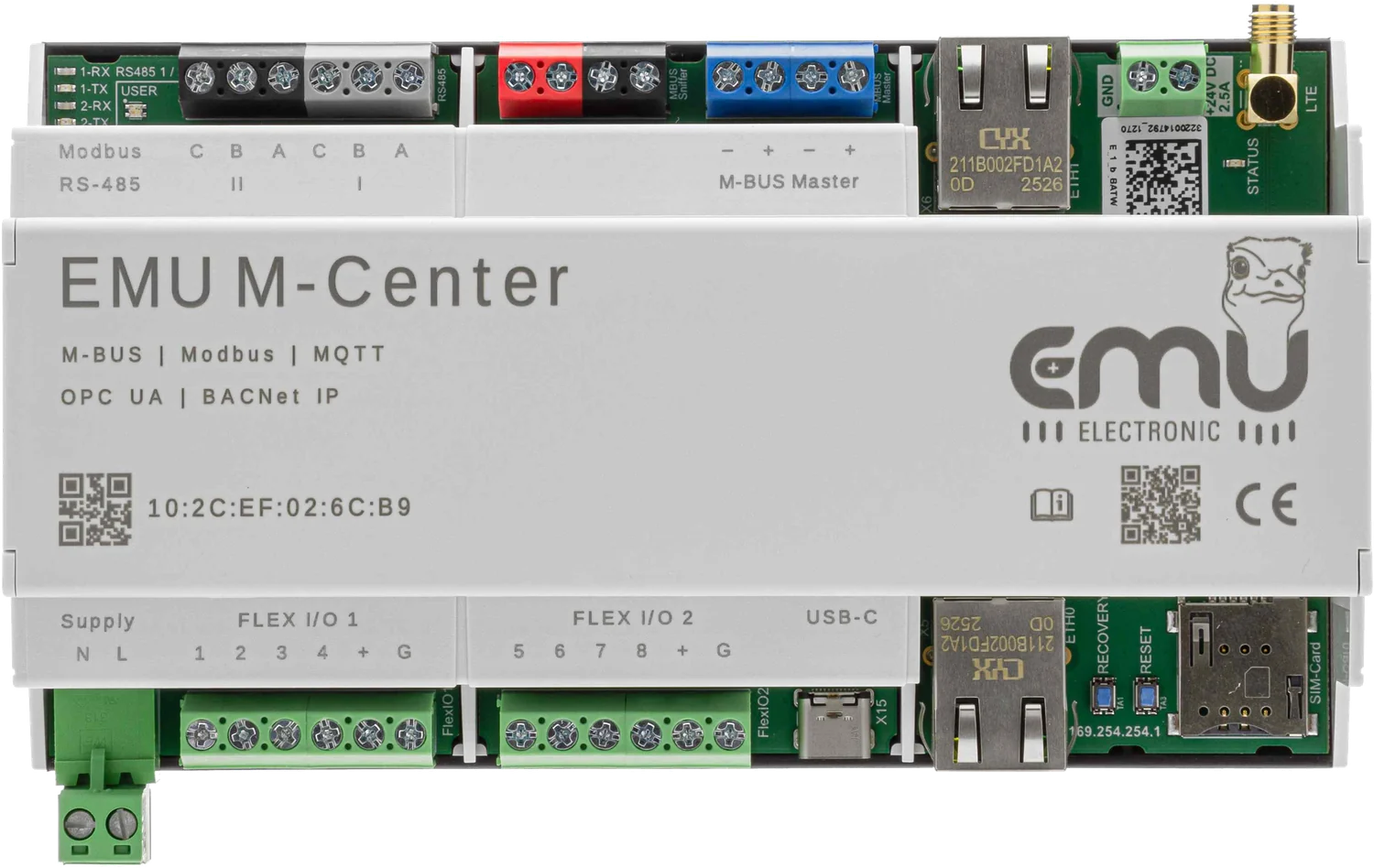
Ask the manufacturer: Which input types can run in one device at the same time?
2. How many meters can it really read?
Two limits matter. The first is electrical: how many standard loads the built-in M-Bus master can supply. The second is commercial: some devices unlock meters in licence steps, so the 33rd or the 65th meter costs extra.
The M-Center supplies 250 standard loads from its own master, without a level converter. To read the meters, it needs the matching input licence for M-Bus, RS-485 or Modbus TCP.
| M-Bus master | EMU M-Center |
|---|---|
| Maximum slaves | 250 standard loads |
| Nominal voltage | 40 V DC |
| Maximum line length | 5000 m at 100 nF/km, max. 90 Ω |
| Baud rates | 300, 2400 and 9600 Bd |
| Topologies | star, tree, line |
| Standard | EN 13757-2 and EN 13757-3 |
Ask the manufacturer: How many standard loads does the master supply without a level converter? Is the number of meters tied to a licence?
3. Can the gateway grow with the building?
A building changes many times over its lifetime. Tenants add sub-meters, the building management system is replaced, an energy management platform is added. A gateway that only covers today’s installation has to be replaced or supplemented later.
With the M-Center, growth is a configuration task:
- New meters: the bus scan finds them by primary or secondary address. The steps are described in the M-Center commissioning guide.
- New target system: MQTT, BACnet IP, OPC UA or Modbus TCP is activated with a licence. The hardware stays.
- New firmware: updates and backups run through Joulio-Web Device Management.
Ask the manufacturer: What does it take to add 100 meters or a second target system: a licence, a setting or another device?
4. How many systems need the data at the same time?
Building management, energy management, billing and the cloud often need the same meter values. Many gateways serve a single protocol. And when a control system polls a Modbus line, no other system can use it at that moment.
The M-Center reads each meter once and passes the values on in parallel: BACnet IP, OPC UA, MQTT, Modbus TCP, an API and CSV, JSON or Excel files via (s)FTP or e-mail. BACnet IP is certified B-ASC and includes BBMD. Each meter appears as its own BACnet device.
Ask the manufacturer: Can BACnet, MQTT, Modbus TCP and file export run at the same time? Can files be sent by e-mail and to an FTP server, in several formats such as CSV, JSON and Excel? Is the BACnet stack certified?
5. How many devices do your service technicians need to know?
Each additional device type means another manual, another configuration tool and other error messages. On a site with three gateways from three manufacturers, faults take longer to find and fewer people in the service team can fix them.
With the M-Center, the technician knows one device. The web interface, the event log and the procedures are the same on every site, whether it is a heat meter in an apartment building or a Modbus line in a factory. Training once is enough.
Ask yourself: How many different devices and tools will our service team need for this site and for the next ten?
6. What do you need to configure it and who keeps the configuration?
Some gateways need a Windows program, a USB cable or an account with the manufacturer. The configuration then sits on the installer’s laptop. If the installer leaves the project, that knowledge often leaves with them.
The M-Center is configured in the web browser, on site or remotely, over HTTPS with password-protected user roles. The configuration is stored on the device and backed up through Joulio-Web. The operator sees exactly what the installer set up.
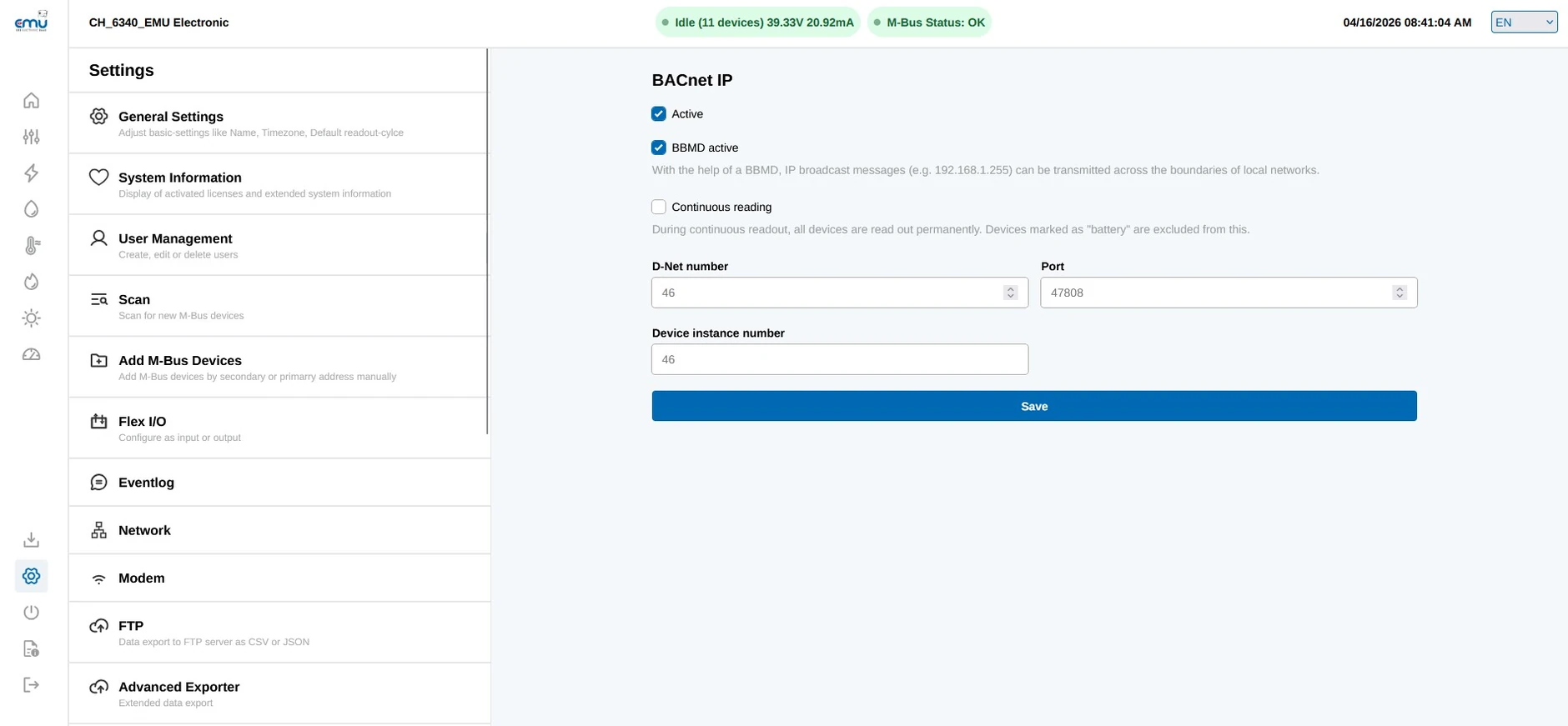
Ask the manufacturer: Can the device be configured fully in the browser? Where is the configuration stored?
7. What happens when the network fails or a meter stops responding?
A missing reading is rarely noticed on the day it happens. Often it shows up months later, in the annual bill.
The M-Center stores several years of meter data on the device and sends it on when the connection is back, for example to the cloud via MQTT. It has two Ethernet ports and a built-in LTE modem for sites without a building network. Status messages, communication faults and outliers are logged around the clock, so a meter that stops responding appears in the event log the same day.
Ask the manufacturer: How long does the device store 15-minute values for all meters? Where do I see a meter that has stopped responding?
8. What does it cost over its lifetime?
Compare more than the purchase price. Subscriptions, licence steps per number of meters and an extra gateway for each target system add up and they grow with every extension.
M-Center licences are paid once. The output licences for MQTT, BACnet IP and Modbus TCP do not depend on the number of meters, provided the M-Center has the input licence for M-Bus, RS-485 or Modbus TCP needed to read them.
Ask the manufacturer: Are licences one-time or yearly? Does the price change with the number of meters?
Common types of M-Bus gateway
| Type | Strength | What to check |
|---|---|---|
| Single-protocol gateway, e.g. M-Bus to BACnet | Simple, focused | Each further target system needs another device; configuration often via PC tool and cable |
| Gateway with licence steps per number of meters | Low entry price | Cost of the next step; electrical load limit of the master |
| Data logger with file export | Suited to billing | Building management and cloud often only as options |
| Multi-protocol data logger: EMU M-Center | All inputs and outputs in one device, in parallel | Choose the licences the project needs, once |