First the inventory, then the technology
The first step is not a technical one. Before any gateway is ordered, you need a list: which meter is where, from which manufacturer, with which protocol, which address and which medium. In many properties this list does not exist – and that is the real reason projects drag on.
Experience shows that such a survey turns up at least one meter that has not been read for years and at least one whose values flow into two systems that contradict each other.
One collection point instead of four reading paths
The classic wrong turn is to connect each protocol separately: an M-Bus level converter here, a Modbus gateway there, a pulse counter in between. It works, but it creates four places where something can fail and four configurations someone has to maintain.
The EMU M-Center brings this together: M-Bus up to 250 devices via the built-in level converter, Modbus RTU up to 64 devices via two RS-485 interfaces, Modbus TCP over Ethernet and up to 8 S0 pulse inputs via the Flex I/O. One device, one interface, one place to look.
Device drivers instead of register tables
With Modbus, the real work is not the wiring but the register table: which value sits at which address, as a 16- or 32-bit number, in which byte order. Doing this by hand for twelve device types produces a configuration nobody can follow any more.
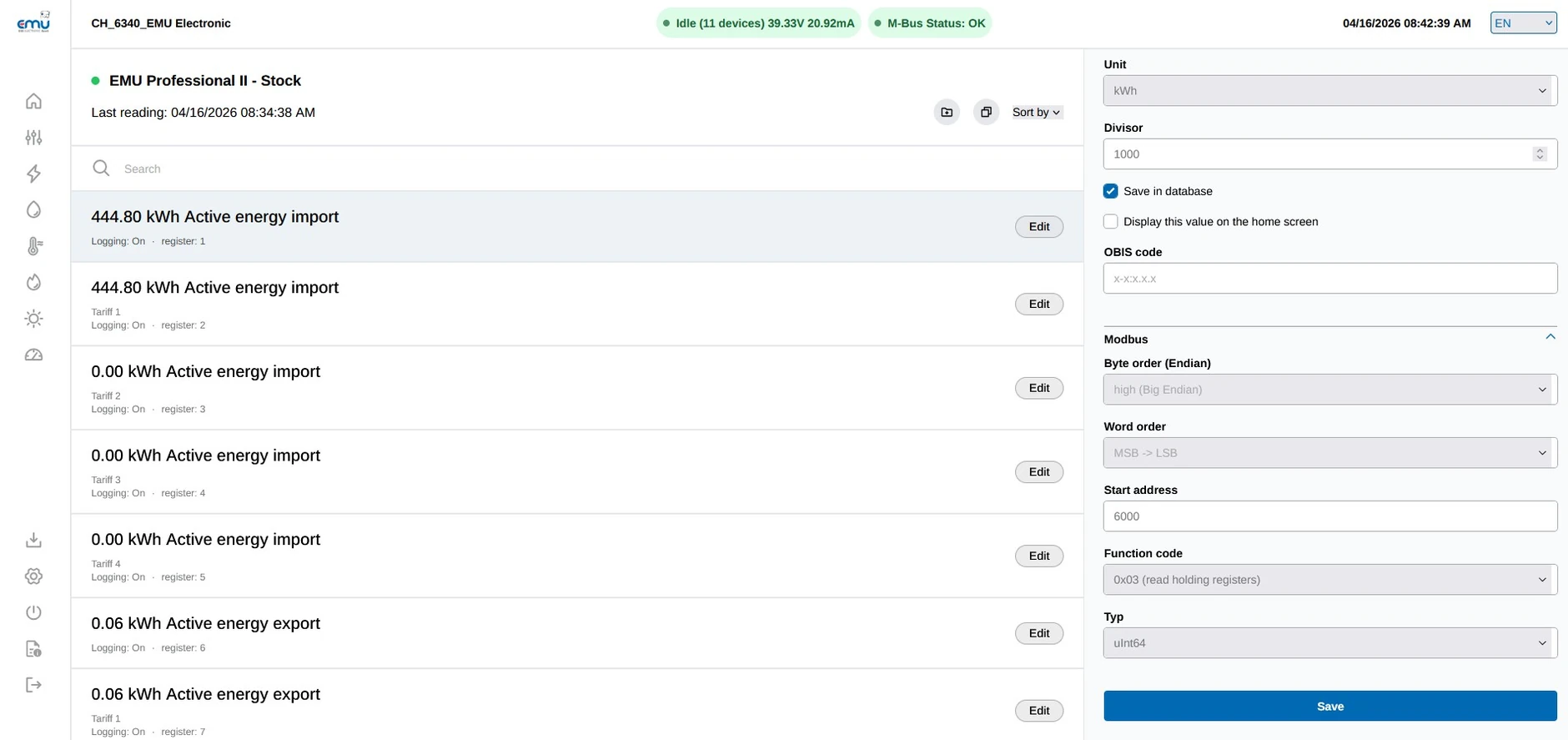
Stored device drivers in Device Management take care of this. Instead of typing addresses, you select the device type – and the readings arrive with names. For M-Bus there is also an automatic search by primary and secondary address; manual additions remain possible.
Read once, use many times
The biggest practical gain is reuse. A building automation system polling a Modbus segment effectively occupies it alone. A central logger reads once and serves several target systems from that at the same time:
- Building automation via BACnet IP or OPC UA
- Cloud and dashboards via MQTT
- Billing via CSV, Excel or JSON by (s)FTP and e-mail
- Analysis and utility cost billing in Joulio-Web
A new target system then means a configuration, not a second set of wiring.
Where most projects tip over
Not during setup, but in operation. A metering point fails, nobody notices, and eleven months later the values for billing are missing. This cannot be repaired after the fact – the values are estimated, and that is where the discussion with the tenants begins.
That is why monitoring belongs in the design from the start: detect and log failed readings, keep an eye on status messages and communication faults, report outliers. With twelve meters you still notice a failure yourself. With 120 you no longer do.