EMU Electronic AG · Baar, canton of Zug

About EMU Electronic AG: Swiss metering for over 35 years

We develop and produce power meters, data loggers and energy management software in Switzerland – from the circuit to the assembled board to the help desk, all from Baar.

35+

years of experience with power meters

4

value-adding steps in Switzerland, including PCBA

5

countries with a presence of our own

1

site for development, assembly and support

Depth of manufacturing

What does Swiss Made mean for a power meter?


At many manufacturers, “Swiss Made” stops at the housing and the company logo. With us it starts at the circuit and extends to the assembled board: PCB assembly takes place in Switzerland. That costs more than sourcing a circuit board abroad – and pays off where delivery reliability, revisions and traceability count.

Development

Circuit design, firmware and the web interface are created in house in Baar. Whoever is responsible for a function sits in the same building as the person who supports it.

PCB assembly (PCBA)

The boards are assembled in Switzerland. Short distances to production mean that component changes, revisions and small series are feasible in weeks rather than quarters.

Final assembly and testing

Assembly, functional testing and marking take place in Switzerland – every device with its own serial number.

Commissioning and support

Project support from planning through integration to commissioning – especially where different meters, protocols and software systems meet.

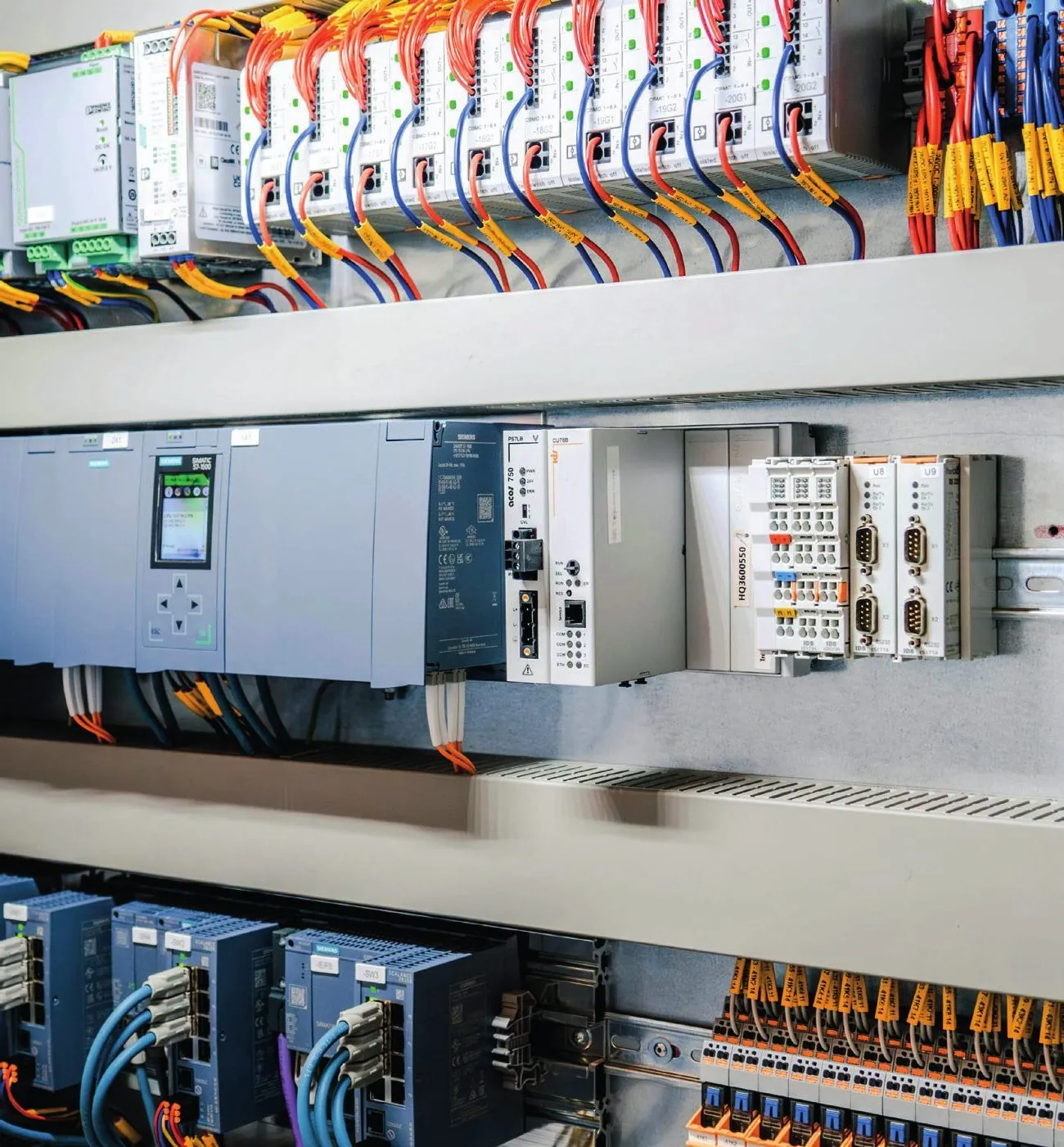
Control cabinet with DIN rail modules, terminal blocks and labelled wiring

How an EMU power meter is made: nine stations from the bare circuit board to the packed device.

0000.00EMU Station 1 / 9 DC 2614Batch L-0412 AOI passed ICT passed Device serial number26460911 Board serial numberPCB-7K3M9A2 Digital twin Batches · date codesAOI · ICT · test resultsCalibration and final statusDigital twin is created Test station Initial testInterfacesLCD cameraKey test Reference system Reference Device under test Calibration recorded permissible limit Measuring points Passed M Quality that countsMade in Switzerland
  1. Station 1 of 9

    SMT board assembly

    The bare circuit board enters the SMT line. Components are placed precisely, and their date codes and batch numbers are captured and assigned to the production record.

    Every component is documented and traceable.

  2. Station 2 of 9

    Automated optical inspection

    A camera checks placement, component orientation and visible solder joints. The result is documented.

    Automated visual inspection for reproducible manufacturing quality.

  3. Station 3 of 9

    In-circuit test

    Test probes are lowered onto the board and electrical test points are measured one after another. Only a board that passes moves on.

    Electrical faults are detected early.

  4. Station 4 of 9

    Assembling the power meter

    Housing, circuit board, display and front are assembled into the meter. The board data stays linked to the device.

    Tested electronics become a complete measuring device.

  5. Station 5 of 9

    Serial numbers and digital twin

    The device serial number and the circuit board serial number are captured and linked digitally. The digital twin is created: batches, date codes and all test results now belong to exactly this device.

    Complete traceability from the component to the finished power meter.

  6. Station 6 of 9

    Initial test and function test

    Initial test, check of the communication interfaces, optical LCD inspection by camera and automated key test.

    Every device is fully tested for its functions.

  7. Station 7 of 9

    Precision calibration

    Under defined test conditions the device is calibrated against a reference measuring system. The calibration values are assigned to the digital twin.

    Precise calibration as the basis of reliable measurement.

  8. Station 8 of 9

    Accuracy test

    After calibration, measuring accuracy is tested separately and compared with the permissible limits. Only then is the device released.

    Every power meter has to pass its accuracy test.

  9. Station 9 of 9

    Laser marking, labelling, packaging

    All tests are checked. The laser marking according to MID requirements is applied, and the device is labelled and packed. Test results are kept for at least 10 years as required by MID.

    Tested, documented and ready for use.

From Landis & Gyr to our own factory

Founded in 1989 as a spin-off from Landis & Gyr. A year later the world’s first digital electricity meter came from here.

2027 EMU Professional II KNX The EMU Professional II with KNX interface.

2023 EMU M-Center M-Bus data logger and gateway with MQTT, BACnet IP and Modbus.

2020 New production line Additional capacity of around 150,000 electricity meters per year.

2017 Joulio-Web Energy management software.

2015 EMU M-Bus Center The next generation of M-Bus data logger.

2012 EMU M-Bus Logger 60 Our first M-Bus data logger.

2011 EMU Professional Market launch of the three-phase electricity meter.

2011 EMU S0 Impulslogger Our first S0 pulse data logger.

2010 Development begins Start of development of the EMU Allrounder and EMU Professional.

2004 Management buy-out Taken over by Hans Koller. Severin Koller takes over as head of sales.

1990 EMU1 The world’s first digital electricity meter.

1989 Company founded Eberli & Muntwyler found the company as a spin-off from Landis & Gyr in Baar.

Why we measure

Our guiding principle is the 2000-watt society. The first step in any energy optimisation is to measure consumption at all – everything else follows.

1Site for development, assembly and support: Baar ZG

35+years of experience with power meters

5Countries with a presence of our own: Switzerland, Germany, UAE, Bosnia and Herzegovina, Saudi Arabia

ISO 50001Joulio-Web is certified for energy management systems

What makes us fast

Tightly organised

Small teams and short paths: decisions are made in Baar, not in lengthy approval rounds.

A large stock

Short delivery times, because the devices are here rather than on their way.

The whole chain

System solutions from measurement to billing, with trained system integrators, scalable from a single-family house to an industrial site.

Group and locations

Which companies belong to the Helventure Group?


EMU Electronic builds electricity and power meters, data loggers and energy management software. The sister company Helvatron manufactures heat and water meters. The other companies in the group bring both product worlds into their markets – with distribution and pre- and after-sales on site.

Manufacturing

Head office · Switzerland

EMU Electronic AG

Development, PCB assembly, final assembly, testing and support for power meters, the M-Center data logger and Joulio-Web.

Jöchlerweg 2
6340 Baar
Switzerland

+41 (0)41 545 03 00
info@emuag.ch

Parking directly in front of the building, Baar station around 8 minutes’ walk away.

Sister company

Helvatron AG

Manufacturer of heat meters and water meters. Together with EMU’s electricity meters, the group covers all the media that are billed in a property.

www.helvatron.com

Distribution and service

Germany

EMU Metering GmbH

Sales and advice for the German market, including accessories such as current transformers.

Friemarer Str. 38
99867 Gotha
Germany

+49 (0)3621 510 40 70
hello@emu-metering.de

EU region

Helvatron GmbH

Distribution of Helvatron devices in the EU – heat and water meters for projects and specialist trade.

Middle East

Helvatron Measuring & Control Systems LLC

Distribution and pre- and after-sales for EMU and Helvatron products. Office and warehouse in Dubai, so that spare parts and replacement devices are available in the region.

Dubai
United Arab Emirates

www.helvatron.com

Southern Europe

Helvatron d.o.o.

Distribution and pre- and after-sales for EMU and Helvatron products in southern Europe.

Sarajevo
Bosnia and Herzegovina

Middle East

Helvatron Consulting

Pre- and after-sales for EMU and Helvatron products in the Kingdom of Saudi Arabia.

Riyadh
Saudi Arabia

Outside these companies we work with sales partners in further European countries – the overview is under International partners.

References

What references does EMU Electronic have?


A selection of the installations where EMU meters are at work:

Buildings and infrastructure

  • Office towers in Riyadh and Dubai
  • Port of Stockholm

Energy generation

  • Hydroelectric power stations of the Uniper Group
  • Erlasee solar park
  • PV installations and self-consumption associations

Utilities and housing

  • Numerous municipal utilities
  • Developments with over 120 flats
  • Tenant electricity and utility cost statements
Swiss alpine panorama at dusk

How we work

How does a workable metering concept come about?


Most projects founder not on the hardware but on a metering concept that does not support the billing later on. That is why a project with us starts with a conversation and – where it is worthwhile – a workshop on site.

  • Site visit and analysis of the existing metering concept
  • Workshop with the people who operate the installation
  • New metering concept, roll-out and commissioning
  • Handover plus ongoing support and optimisation

Let’s talk about your project.


Whether it is a new build, a refurbishment or a meter estate that has grown over the years and should finally deliver data – we will tell you openly what our devices can do and what they cannot.

Phone
+41 (0)41 545 03 00

General
info@emuag.ch

Technical support
helpdesk@emuag.ch

Orders Switzerland
orders@emuag.ch